Lanhydrock: Fire, Family and Ghosts in a Cornish Great House

From monastic land to a great Cornish estat
There is something unusual about Lanhydrock. From the moment you approach through its great stone gatehouse, the house seems older than the comfortable Victorian rooms waiting inside suggest. Its granite walls belong to one century, its kitchens and nurseries to another, and its stories reach back further still, into monastic Cornwall, civil war, devastating fire and one of the county’s most enduring ghost legends.
Standing among more than 900 acres of wooded estate near Bodmin, Lanhydrock today is one of Cornwall’s great country houses. Yet much of the building visitors walk through is not as old as it looks. The Lanhydrock we see now was largely born from catastrophe, rebuilt after a fire that destroyed much of the house in 1881 and brought tragedy to the family who lived there.
Long before the Robartes family arrived, the land formed part of the medieval possessions of the Augustinian priory of St Petroc at Bodmin. After Henry VIII’s Dissolution of the Monasteries, it passed through several families before being bought in 1620 by Richard Robartes, a wealthy Cornish merchant whose fortune had grown alongside the local tin industry. Richard began creating the country seat that would announce the family’s arrival among Cornwall’s elite, although it was his son John Robartes who completed most of the great house during the first half of the 17th century.
Civil war, survival and decline
John was a committed Parliamentarian and Puritan, and Lanhydrock still carries the marks of his beliefs. The extraordinary ceiling of the Long Gallery, completed during the 1630s, depicts scenes from the Book of Genesis. Beneath it survives John’s library, containing thousands of books printed before 1700. They are remarkable survivals, partly because the house around them was destined to endure both war and fire.
When the Civil Wars began in the 1640s, John Robartes sided with Parliament. Royalist forces seized Lanhydrock in 1644 and Robartes fled to Plymouth, later reclaiming the estate after the war. The great gatehouse and avenues that now make the approach to Lanhydrock feel so theatrical belong to this long period of rebuilding, landscaping and asserting the family’s place in Cornwall.
Yet for much of the following century the enormous house was barely a home at all. One visitor in 1736 found it badly neglected and almost empty, while later owner Mary Vere Robartes considered the estate so troublesome that demolition was contemplated.
The fire that changed everything
Lanhydrock’s fortunes revived during the 19th century. Thomas James Agar-Robartes inherited the estate in 1861, although he had already been closely involved with it for years. He and his wife Juliana Pole-Carew had the wealth to transform the house, bringing in the celebrated architect George Gilbert Scott and his associate Richard Coad. Rooms were remodelled, formal gardens laid out and the estate reshaped into the imposing Victorian seat the family wanted it to be.
Then, in April 1881, much of it burned.
The fire devastated the recently improved south range and most of the western side of Lanhydrock. A firebreak prevented the flames from consuming the north wing, saving the Long Gallery, its 17th-century ceiling and its historic library. The building could be repaired. What happened to the family was harder to mend.
Juliana was rescued from the house but died several days later from the effects of smoke inhalation. Her husband Thomas survived her by less than a year. The National Trust records the family tradition that he died from a broken heart.
Rebuilding Lanhydrock
Their son, Thomas Charles Agar-Robartes, inherited the estate and undertook the immense task of rebuilding. By 1885 the family had returned to a house reconstructed on much of the old footprint but equipped with the conveniences expected of a wealthy late-Victorian household. Fireproofing was improved, electricity introduced, and behind the grand rooms a sophisticated domestic machine developed: kitchens, larders, sculleries and servants’ quarters designed to support an aristocratic family and its guests.
This is one of the reasons Lanhydrock feels different from many country houses today. Its most memorable rooms are not necessarily the grandest. Downstairs, the kitchens and service rooms remain astonishingly complete. Upstairs are bedrooms, nurseries and family spaces filled with the ordinary evidence of extraordinary lives.
The National Trust now interprets the house through the Robartes family, the Victorian children and the servants who kept the household running, rather than presenting it simply as a sequence of decorated rooms.
War and another family tragedy
The family story carries another tragedy. Thomas and Mary Agar-Robartes raised ten children at Lanhydrock. Their eldest surviving son and heir, Thomas Charles Reginald Agar-Robartes, known as Tommy, became an MP and served with the Coldstream Guards during the First World War.
He died in 1915 from wounds received at the Battle of Loos.
The loss profoundly affected the family, and the bedrooms and possessions that remain at Lanhydrock make that history unusually personal. This is not a house where the past feels abstract. It remains tied to specific people, specific rooms and specific losses.
By the middle of the 20th century the age of great private estates was fading. Gerald Agar-Robartes gave Lanhydrock and part of its collection to the National Trust in 1954. When his sister Everilda later died, the remaining contents followed.
The result is the house visitors see today: part Jacobean survivor, part Victorian reconstruction, and part family archive.
The ghosts of Lanhydrock
And then there are the ghosts.
One of the best-known stories concerns a woman in grey, reportedly seen in the Long Gallery and elsewhere in the house. Modern Cornish tourism accounts associate the apparition with Lady Juliana Robartes, whose death followed the fire of 1881.
Visitors and staff have also reported the unexplained smell of cigar smoke, particularly in rooms associated with the men of the household, as well as footsteps, shadowy figures and the sound of children in areas of the house that are empty.
These are ghost stories rather than established history, but they have become sufficiently associated with Lanhydrock to feature in Visit Cornwall’s own account of Cornwall’s haunted places.
A night inside the house
Some of the stories were formally explored in 2004 when members of a paranormal research group were permitted to spend a night inside Lanhydrock. Contemporary reporting of the vigil recorded two investigators hearing what they described as the laughter of a young girl in the Nursery Suite.
In the Long Gallery, members of the group, reportedly accompanied by Lanhydrock staff, heard a loud noise likened to a heavy piece of furniture being dragged across the wooden floor.
The house manager at the time acknowledged that staff and visitors had previously reported unexplained sensations and apparent presences around the property.
None of this establishes a supernatural explanation, but it does provide a documented history of the stories being told by people inside the house rather than legends invented generations later for tourists.
Jan Tregeagle and the darker folklore of Lanhydrock
There is also an older and distinctly Cornish presence attached to Lanhydrock: Jan Tregeagle.
Tregeagle is one of the great damned souls of Cornish folklore, a corrupt steward whose ghost was supposedly condemned to perform impossible tasks for eternity while pursued by the Devil and his hounds.
Versions of the story vary wildly, as good folklore tends to do, but the connection to Lanhydrock is genuine within the tradition. The National Trust describes Tregeagle as a 17th-century steward associated with the estate who later became one of Cornwall’s enduring legendary figures.
Cornwall Heritage Trust preserves the traditional tale in which Tregeagle served Lord Robartes, abused his position and was ultimately called back from the dead to settle a dispute over rent.
Once summoned, the story says, Tregeagle could not be returned peacefully to his grave. His spirit became such a torment that he was eventually condemned to empty Dozmary Pool using a limpet shell with a hole in it, forever trying to complete a task that could never be finished.
Other versions send him racing across Cornwall with hell-hounds at his heels, his cries carried on the wind from the moors to the coast.
It is folklore rather than biography, but its connection with Lanhydrock is old enough that the National Trust continues to tell the story at the estate today.
Lanhydrock today
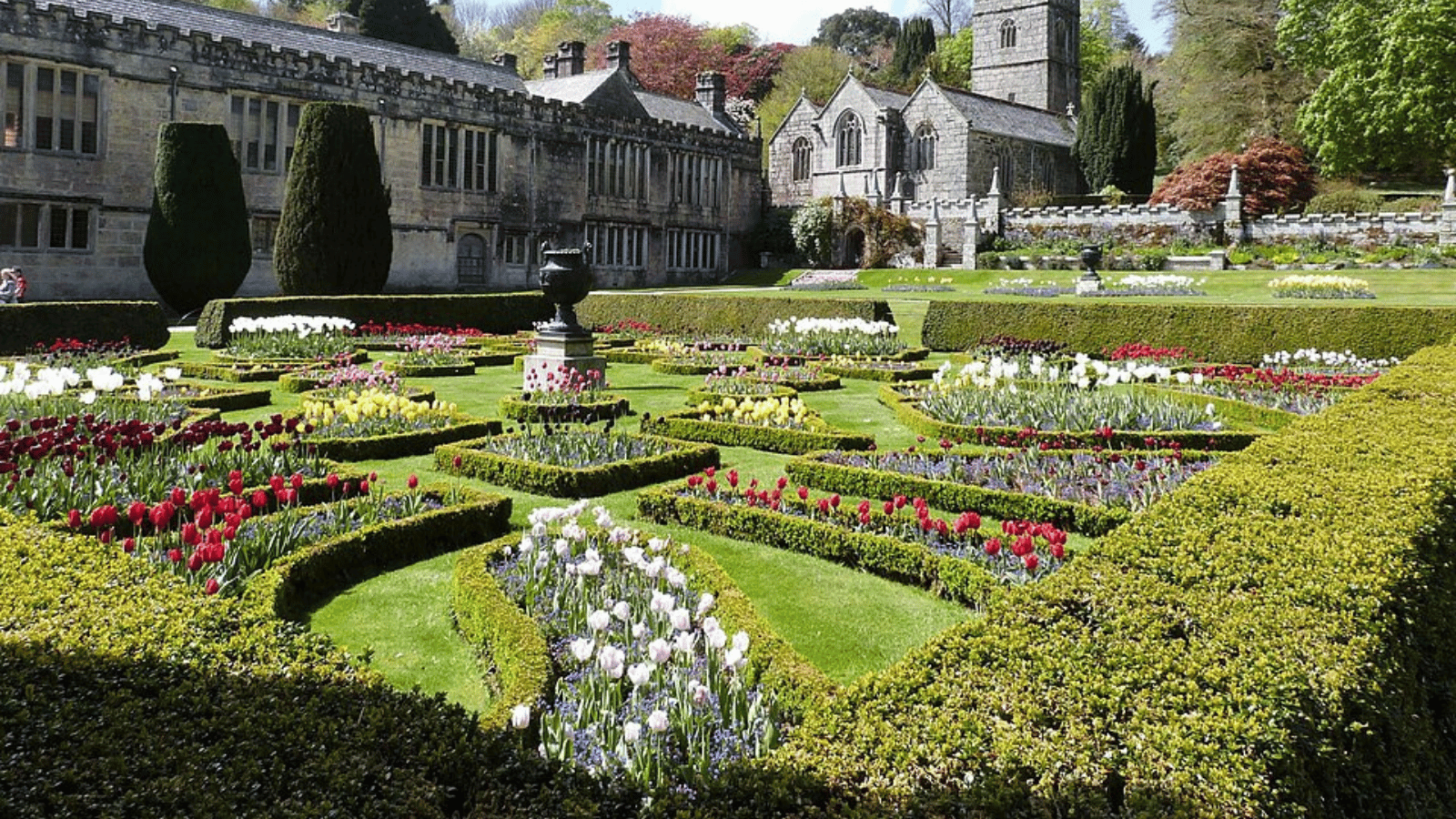
Outside the house, Lanhydrock changes character again. Formal gardens give way to woods and parkland, old estate roads and traces of earlier landscapes. There are remnants of a medieval deer park, the remains of a Victorian swimming pool, old tin workings and the great avenue through which generations of visitors approached the house.
The gardens themselves have changed repeatedly over four centuries, from orchards and kitchen gardens to bowling greens, elaborate Victorian planting and the magnolias for which Lanhydrock is now particularly known.
It is easy to visit Lanhydrock simply because it is beautiful. The gatehouse, gardens and wooded estate are enough to make it one of the great days out around Bodmin.
But the reason it stays with you is the feeling that this was never simply a showpiece. People were born here, worked here and grieved here. Children played in its nurseries. Servants crossed its corridors before dawn. A family watched much of its home burn around them. One son went away to war and did not return.
Long before any visitor reported footsteps or laughter in empty rooms, Lanhydrock had accumulated more than enough memories of its own.
Whether any of those memories still walk the Long Gallery is another matter entirely.
Sources
National Trust – The history of Lanhydrock
https://www.nationaltrust.org.uk/visit/cornwall/lanhydrock/the-history-of-lanhydrock
National Trust – Visiting Lanhydrock House
https://www.nationaltrust.org.uk/visit/cornwall/lanhydrock/visiting-the-house-at-lanhydrock
National Trust – History of the gardens at Lanhydrock
https://www.nationaltrust.org.uk/visit/cornwall/lanhydrock/history-of-the-garden-at-lanhydrock
National Trust – The legend of Jan Tregeagle at Lanhydrock
https://www.nationaltrust.org.uk/visit/cornwall/lanhydrock/events/97df0c6c-21fc-47bf-a5b6-d7606f26a07f
Cornwall Heritage Trust – Tregeagle
https://www.cornwallheritagetrust.org/learn/resources/stories-and-rhymes/tregeagle/
Visit Cornwall – Cornwall’s myths, beasts and ghostly encounters
https://www.visitcornwall.com/things-to-do/insider-recommendations/myths-beasts-and-ghostly-encounters-cornwall-s-haunting-legends
Historic England – Lanhydrock House
https://historicengland.org.uk/listing/the-list/list-entry/1157870